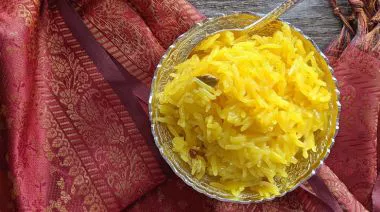
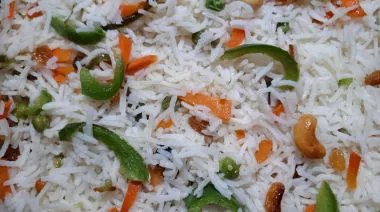
Meethe chawal has a striking, bright yellow appearance, achieved via the infusion of saffron and sometimes food colouring. The rice is first partially cooked, then slow-cooked with spices, ghee, and sugar until each grain is perfumed, separated and glossy. The dish is commonly prepared to celebrate the festival of Vasant Panchami.
Wash the rice thoroughly under running water until the water runs clear. Soak the rice in 2 inches of water for 30 minutes at room temperature. While the rice soaks, prepare the saffron water. Take ¼ teaspoon of saffron strands and soak them in 2 tablespoons of warm water or warm milk. If using food colour, you can add ¼ teaspoon orange food colour to 2 tablespoons of water instead. After 30 minutes, drain the soaked rice completely and set it aside.
Description - Step 2
Roasting dry fruits and coconut
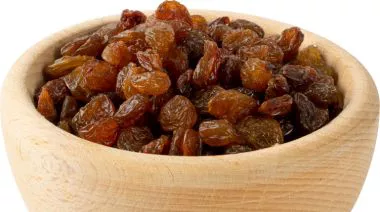
Heat a large heavy-bottomed kadai on low to medium heat. Add 2 tablespoons of ghee from the total quantity. Once the ghee melts and becomes hot, add 8 cashew halves to the ghee. Roast while stirring continuously for 1-2 minutes. Add 5 chopped almonds and continue roasting. Now add 2 teaspoons of raisins and 2 teaspoons of chopped dry coconut pieces. Keep stirring constantly on a low flame, as dry fruits can burn quickly. Roast until the cashews and almonds are golden brown, and the raisins puff up slightly, around 3-4 minutes total. Remove all the dry fruits and coconut from the ghee and transfer them to a plate. Keep them aside. Reserve the ghee in the same kadai.
Description - Step 3
Cooking rice with aromatics
To the remaining ghee in the same kadai, add 2 green cardamom pods and 4 cloves. Let them sizzle and release their aroma for 10-15 seconds on medium heat. Pour in 1 cup of water and bring it to a boil. Add the soaked saffron water with its strands and the orange food colour. Stir well to mix the colour evenly throughout the water. Once the water comes to a rolling boil, add the soaked and drained basmati rice. Spread it out evenly in the kadai. Let the rice cook on medium heat without covering. The water will start to bubble, and the rice will begin cooking. Cook for about 8-10 minutes.
Description - Step 4
Adding sugar and the remaining ghee
When the rice is 70% cooked, and most water has been absorbed, reduce the heat to low. Gently mix the rice with a fork or spoon to fluff it up and separate the grains. Add ½ cup of sugar, spreading it evenly over the rice. Pour in the remaining ghee from the ¼ cup total that was reserved. Add the roasted dry fruits (cashews, almonds, raisins, and coconut) that were set aside earlier, reserving a small portion for garnishing. Using a folding motion with a fork, mix everything. Be very careful not to break the rice grains. Mix until the sugar starts melting and coating the rice grains.
Description - Step 5
Final slow cooking (dum)
Once everything is mixed, cover the kadai with a tight-fitting lid. Reduce the heat to the lowest possible setting. Let the meethe chawal cook on this very low heat for 5-7 minutes. During this time, the sugar will melt completely and coat each grain. Open the lid once after 3-4 minutes and give the rice a light stir from the bottom to prevent any sticking or burning. Cover again and cook for the remaining time. After 5-7 minutes, turn off the heat. Let it sit covered for another 2 minutes with the residual heat.
Description - Step 6
Final fluffing and garnishing
Remove the lid from the kadai. You will see the meethe chawal is now fully cooked with bright golden-yellow grains that are separate, glossy, and fragrant. Using a fork, gently fluff the rice from the bottom, bringing the rice from underneath to the top. Check that no grains are sticking to the bottom. The rice should be dry and have a sheen, with each grain coated with a thin layer of ghee and sugar. Transfer to a serving dish or bowl. Garnish generously with the reserved roasted dry fruits.
 Search
 Login
Login Indian
 Intermediate
 Dessert