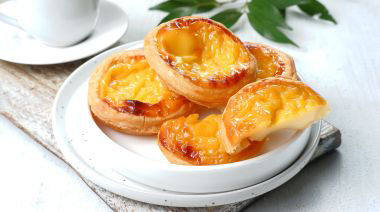
Calling pastel de nata a custard tart would be a stretch, because it is not the same as the English tart. Portugal's most famous dessert is known for its flaky pastry shell and rich custard filling. The difference lies in the crust used – custard tart uses a shortcrust pastry, which tends to be dense, while the Portuguese custard tarts are made with layered puff pastry that is baked into flaky layers, which are much lighter.
These tarts originated in Lisbon, in the early 1800s, via Catholic monks at the Jerónimos Monastery in the Belém district. Today they are enjoyed around the world, and the Chinese egg tart or dantat, invented in the early 1900s, is said to have been inspired by the Portuguese custard tart. A traditional pastel de nata recipe consists of crisp puff pastry filled with an egg-based custard that is baked at a high temperature until the top develops its characteristic golden-brown spots.
Portuguese custard tarts are distinguished by their caramelised surface and light, flaky layers of pastry. The filling is made using a simple custard recipe of milk, sugar, egg yolks and flour. Many versions also include lemon peel and cinnamon, which add subtle flavour without overpowering the custard. The mixture is cooked until smooth before being poured into pastry cases.
Ingredients
UNITSIngredients
2 cupsPlain flour (extra for dusting) For the pastel de nata dough
¼ tspSea salt
¾ cupCold water
225gUnsalted butter (softened)
3 tbspPlain flour (For the custard)
1¼ cupsWhole milk (divided)
1⅓ cupsGranulated sugar
1Cinnamon stick
⅔ cupWater
½ tspVanilla extract
6Large egg yolks (whisked)
as neededIcing sugar (For the garnish)
as neededGround cinnamon
Follow
Directions
Description - Step 1
Step 1: Preparing the dough
Fix a stand mixer with a dough hook. To the bowl, add the flour, sea salt, and cold water while the machine is running until a soft dough forms. It should pull away from the side of the bowl.
Description - Step 2
Step 2: Kneading the dough
Flour a work surface generously and turn out the dough on it. Pat it into a 6-inch square, use a pastry scraper. Sprinkle some flour on the dough and cover with plastic wrap, letting it rest for 15 minutes.
Description - Step 3
Step 3: Kneading the dough
Roll the dough into an 18-inch square, making sure that the dough is not sticking to your work surface. Get rid of any excess flour from the top and trim uneven edges.
Description - Step 4
Step 4: First butter fold
Roll the dough into a square. Spread one-third of the softened butter over the left two-thirds of the dough, leaving a 1-inch border around the edges. Fold the right third over the centre, then fold the left third over the top, like folding a letter. Press gently to remove air bubbles and seal the edges.
Description - Step 5
Step 5: Second butter fold
Turn the dough 90 degrees so the folded edge faces you. Roll it back into a square and spread another one-third of the butter over the left two-thirds. Repeat the letter fold: right third over the centre, then left third over the top. Press gently and brush away any excess flour.
Description - Step 6
Step 6: Final rolling and butter layer
Turn the dough 90 degrees again and roll it into an 18 x 21-inch rectangle. Spread the remaining butter evenly over the entire surface.
Description - Step 7
Step 7: Rolling and chilling the pastry
Use a spatula if needed, and roll the dough tightly into a log from the edge closest to you. Trim the ends, cut the log in half and wrap each piece in cling film. Chill for at least 2 hours or overnight.
Description - Step 8
Step 8: Starting the custard
Whisk the flour with ¼ cup milk in a medium bowl until lump-free. In another saucepan, heat the remaining 1 cup of milk until just below boiling. Gradually whisk the hot milk into the flour mixture until smooth.
Description - Step 9
Step 9: Making the Sugar Syrup
In a small saucepan, combine the sugar, cinnamon stick and water. Bring to the boil and cook until the syrup reaches 104°C. Do not stir.
Description - Step 10
Step 10: Finishing the Custard
Remove the cinnamon stick from the syrup. Slowly pour the syrup into the milk mixture, whisking constantly. Stir in the vanilla extract and leave to cool slightly. Whisk in the egg yolks until combined. Strain the custard into a bowl, cover and set aside until needed.
Description - Step 11
Step 11: Preparing the Oven and Pastry
Place an oven rack in the upper third of the oven and preheat to 290°C for 30 minutes. Roll one chilled pastry log into a 16-inch cylinder and cut into ¾-inch pieces.
Description - Step 12
Step 12: Lining the Muffin Tin and Baking
Place one piece of pastry into each well of a 12-cup mini muffin tin. Using damp thumbs, press the dough into the base and up the sides, leaving a slight lip above the rim. Fill each pastry case about three-quarters full with custard. Bake for 8-9 minutes, or until the pastry is golden and the custard has developed dark caramelised spots.
Description - Step 13
Step 13: Cooling and Serving
Leave the tarts to cool in the tin for a few minutes before transferring to a wire rack. Dust with icing sugar and ground cinnamon, then serve warm. Repeat with the remaining pastry and custard.
A traditional custard tart uses shortcrust pastry and a smooth baked custard. A Portuguese tart (pastel de nata) uses flaky puff pastry and a caramelised custard with charred spots.
Custard tarts exist in several cuisines. Portuguese pastéis de nata originated in Portugal, while Chinese egg tarts evolved later, influenced by both British custard tarts and Portuguese pastries.
Pastel de nata has a flaky laminated pastry shell and a caramelised custard filling. Traditional custard tarts usually feature shortcrust pastry, a firmer custard and no caramelised top.
The four main tart categories are custard tarts, fruit tarts, savoury tarts and cream or chocolate tarts. Each uses a pastry shell with a different style of filling.
The three main types of custard are stirred custard, baked custard and steamed custard. They differ in cooking method, texture and the way the eggs are set.